CNC Router Business: Challenges, Models & Growth
In this article
- CNC Router Business: Industry Challenges, Business Models & Growth Opportunities
- Introduction
- 1. Major Problems Faced by CNC Router Business Owners
- Problem 1: Price Competition and Compromising on Quality
- Problem 2: Lack of Skilled Designers and CNC Programmers
- 2. Two Popular CNC Router Business Models
- Business Model 1: Direct Manufacturing – B2C Model
- Business Model 2: CNC Job Work – B2B Model
- 3. How Can You Scale a CNC Router Business?
- Opportunity 1: Develop Your Own Ready-Made Product Collection
- Opportunity 2: Build a B2B Bulk Supply Network
- Opportunity 3: Combine B2B and B2C Sales
- 4. Why In-House Designing and Programming Matter
- 5. Learn ArtCAM Designing and CNC Programming with NIDS CNC SOLUTIONS
- Conclusion: Build a Quality-Focused and Scalable CNC Business
CNC Router Business: Industry Challenges, Business Models & Growth Opportunities
Introduction
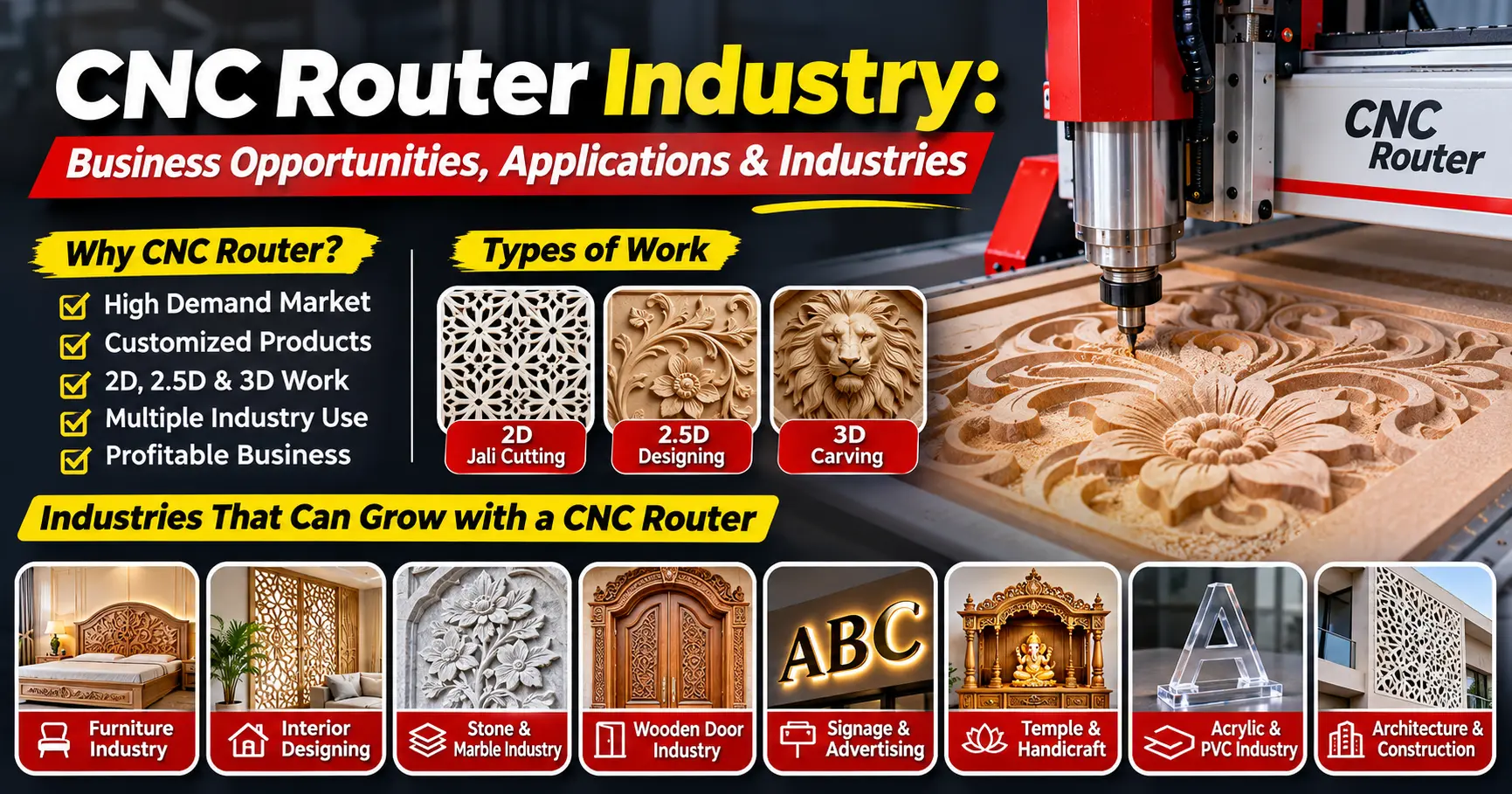
The CNC Router Business offers excellent opportunities in the furniture, wooden manufacturing, interior decoration and stone industries. However, owning a CNC Router machine does not automatically guarantee a successful business. Many machine owners and manufacturers face challenges related to pricing, product quality, design skills, production costs and customer acquisition.
In today's competitive market, businesses often try to attract customers by reducing their prices. But continuously lowering prices is not a sustainable business strategy. Instead, manufacturers need to focus on product quality, skilled design work, efficient production and better customer service.
Another major challenge is the lack of skilled professionals who understand designing, CAD/CAM programming and CNC machine operation. Many businesses depend on external designers for their production requirements, which increases their overall costs and reduces their control over the production process.
In this article, we will explore the major challenges in the CNC manufacturing industry, understand two popular business models and discuss how businesses can expand from small job-work operations to larger manufacturing and supply businesses.
1. Major Problems Faced by CNC Router Business Owners
Before discussing business growth, it is important to understand the common problems faced by CNC machine owners and manufacturers.
Problem 1: Price Competition and Compromising on Quality
One of the biggest challenges in the CNC manufacturing industry is price competition.
When multiple businesses offer similar products or cutting services, customers often compare prices and choose the cheapest option. To compete, some manufacturers continuously reduce their prices.
Unfortunately, this creates a situation where businesses start compromising on product quality, finishing, material selection and production standards.
For example, a furniture manufacturer may receive an order for decorative MDF panels. Instead of focusing on accurate cutting, proper finishing and design quality, the manufacturer may reduce the price to win the order.
Over time, this approach can affect customer satisfaction and business profitability.
What is the better approach?
Instead of competing only on price, businesses should focus on:
-
Better cutting accuracy and finishing.
-
High-quality materials and proper tool selection.
-
Unique and customized designs.
-
Consistent product quality.
-
Professional customer service.
-
Value-added products that competitors cannot easily offer.
A customer who receives a premium-quality product is often willing to pay more for better finishing, durability and customization.
The goal should not be to become the cheapest manufacturer in the market. The goal should be to become a reliable manufacturer known for quality.
Problem 2: Lack of Skilled Designers and CNC Programmers
Another major challenge is the shortage of skilled professionals in the CNC industry.
Many business owners know how to operate a machine at a basic level but do not have sufficient knowledge of CAD/CAM designing, toolpath creation and 3D relief modelling.
As a result, they depend on external designers or purchase ready-made CNC designs from other sources.
This creates several problems:
-
Additional design purchasing costs.
-
Delays when new designs are required.
-
Limited customization options.
-
Dependency on external designers.
-
Difficulty in making quick design changes.
-
Reduced control over production planning.
Imagine a furniture manufacturer receiving 20 different customized design orders. If every design needs to be purchased from an external designer, the total design cost can become significant.
Now imagine the same business having an in-house designer who can create designs, generate toolpaths and prepare files for CNC production.
The business can reduce external design expenses, respond faster to customer requirements and develop its own collection of products.
The real advantage is having complete in-house control over the production process.
When designing, programming and machine operation are handled within the same business, communication becomes easier and production becomes more efficient.
2. Two Popular CNC Router Business Models
In the wooden furniture and stone manufacturing industries, businesses generally operate through two common models: B2C manufacturing and B2B job-work services.
Understanding these models is important before investing in a CNC Router machine.
Business Model 1: Direct Manufacturing – B2C Model
In the B2C (Business-to-Consumer) model, the machine owner handles the complete manufacturing process.
The business receives an order directly from the customer, creates or prepares the design, performs CNC cutting and completes the remaining manufacturing and finishing work.
The final product is then delivered directly to the customer.
Example in the Wooden Industry:
A customer wants a customized wooden temple, decorative door, designer furniture panel or MDF partition.
The manufacturer handles:
-
Customer requirements and design selection.
-
CAD/CAM designing and programming.
-
CNC cutting and carving.
-
Assembly and finishing.
-
Final product delivery.
Example in the Stone Industry:
A customer wants a customized marble nameplate, decorative stone panel or religious carving.
The business manages the design, CNC engraving or carving, finishing and final delivery, depending on its machine capabilities and production setup.
Advantages of the B2C Model:
-
Direct customer relationships.
-
More control over product quality.
-
Opportunity to develop your own brand.
-
Ability to offer customized products.
-
Potential to earn from the complete product rather than only cutting charges.
-
Greater control over product pricing and presentation.
However, this model also requires additional investment in labour, materials, finishing equipment, storage, marketing and customer management.
Business Model 2: CNC Job Work – B2B Model
The second popular model is B2B (Business-to-Business) job work.
In this model, the CNC machine owner provides cutting or carving services to other businesses instead of manufacturing and selling the complete product.
For example, furniture shops, interior designers, carpenters and wooden door manufacturers may receive customer orders that require CNC cutting.
Instead of purchasing their own CNC Router machine, they outsource the cutting work to a nearby CNC service provider.
How Does It Work?
-
A furniture shop or interior designer receives an order.
-
The customer or business provides the required material, such as MDF or wood.
-
The design or CNC file is supplied or prepared according to the agreement.
-
The CNC machine owner performs the required cutting or carving.
-
The processed material is returned to the furniture shop or designer.
-
They complete the remaining assembly, finishing and customer delivery.
The CNC machine owner generally earns cutting or job-work charges, while the furniture manufacturer or interior designer handles the final product.
Advantages of the B2B Model:
-
Regular work from local furniture shops.
-
Business opportunities through interior designers and contractors.
-
Less responsibility for final product assembly and finishing.
-
Possibility of handling multiple business clients.
-
Opportunity to build long-term professional relationships.
-
Potential for repeat orders.
The same model is also common in the stone industry, where stone suppliers, marble shops, interior designers and contractors outsource engraving and carving work to CNC service providers.
However, one limitation of this model is that machine owners mainly earn service charges. Their revenue depends on the volume of cutting work, pricing agreements and machine utilization.
3. How Can You Scale a CNC Router Business?
Both B2B and B2C models can be useful when starting a CNC manufacturing business. But businesses should also think about how to expand beyond individual orders and small job-work projects.
One important opportunity is developing standardized products that can be manufactured repeatedly.
Opportunity 1: Develop Your Own Ready-Made Product Collection
Instead of waiting for customers to bring individual cutting orders, a CNC business can develop its own collection of ready-to-sell products.
For example, a wooden manufacturing business can create:
-
Standard MDF Jali Designs.
-
Decorative Wall Panels.
-
Wooden Door Panels.
-
Mandir Decorative Components.
-
Designer Furniture Panels.
-
Room Partition Designs.
-
Customized Name Plates.
Similarly, a stone manufacturing business can develop:
-
Standard Marble Name Plates.
-
Decorative Stone Panels.
-
Religious Relief Designs.
-
Stone Wall Decoration Products.
-
Engraved Decorative Components.
The business can manufacture selected designs regularly and maintain ready stock according to market demand.
This creates an opportunity to serve both individual customers and bulk buyers.
Opportunity 2: Build a B2B Bulk Supply Network
Once a business has a collection of standardized products, it can approach other businesses that regularly require these products.
Potential B2B customers include:
-
Furniture shops.
-
Interior designers.
-
Wooden door manufacturers.
-
Modular furniture companies.
-
Building material suppliers.
-
Marble and granite shops.
-
Construction contractors.
-
Architecture and interior studios.
For example, instead of waiting for an individual customer to order one MDF Jali panel, you can approach 20 furniture shops and offer them a catalogue of ready-made designs.
These businesses can purchase products in bulk or place repeat orders according to their customer requirements.
The same strategy can be applied to stone decorative panels and other CNC-manufactured products.
Opportunity 3: Combine B2B and B2C Sales
A strong CNC manufacturing business does not necessarily need to depend on only one business model.
It can operate through multiple revenue channels:
B2B Job Work: Provide cutting and carving services to furniture shops, interior designers and other manufacturers.
B2B Product Supply: Manufacture standardized products and supply them in bulk to retailers and distributors.
B2C Direct Sales: Sell finished products directly to homeowners, businesses and individual customers.
Customized Manufacturing: Accept premium customized orders where customers require special designs and finishing.
This approach helps businesses explore different customer segments instead of depending entirely on job-work orders.
4. Why In-House Designing and Programming Matter
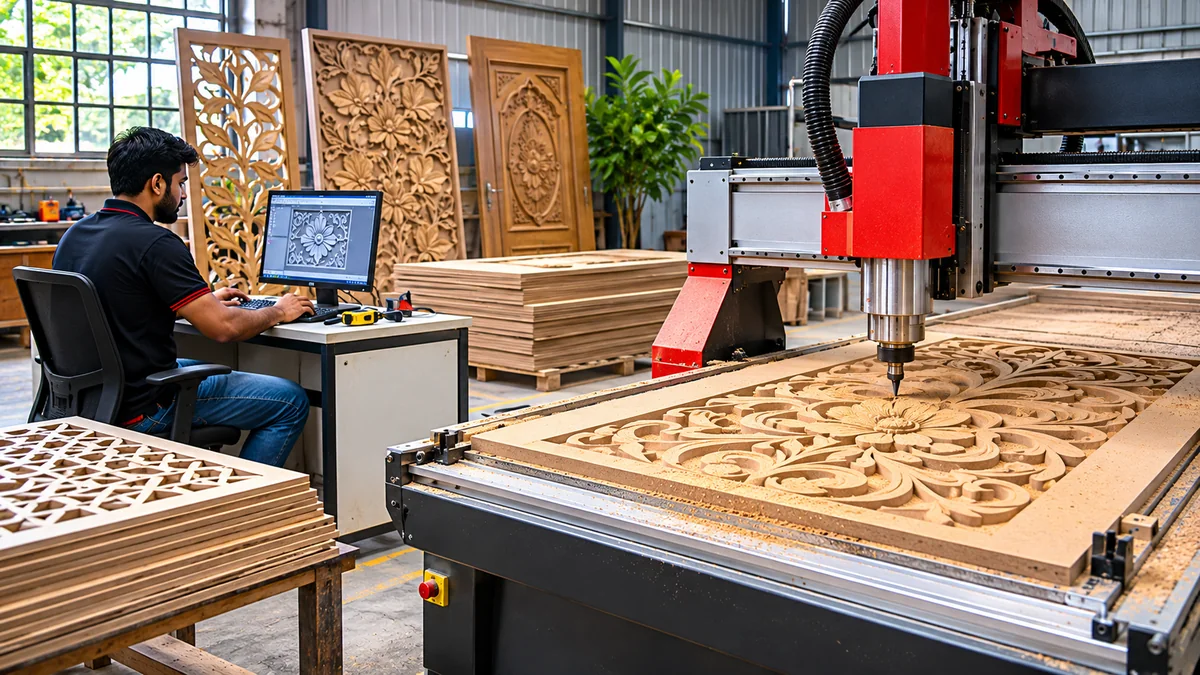
One of the most valuable investments for a CNC manufacturing business is developing its own technical team or acquiring in-house designing and programming skills.
A business that understands the complete process can manage its production more independently.
Consider the complete workflow:
Designing → CAD/CAM Programming → Toolpath Generation → CNC Machine Operation → Cutting → Finishing → Final Product
When these activities are handled in-house, the business can:
-
Reduce dependency on external designers.
-
Control design and programming expenses.
-
Create customized designs according to customer needs.
-
Make faster design modifications.
-
Develop unique product collections.
-
Improve production planning.
-
Maintain better control over product quality.
For entrepreneurs who want to enter the CNC industry, learning ArtCAM and CAD/CAM programming can provide a significant technical advantage.
5. Learn ArtCAM Designing and CNC Programming with NIDS CNC SOLUTIONS
Owning a CNC Router machine is only one part of building a manufacturing business. Understanding how to create designs, generate toolpaths and operate the machine is equally important.
At NIDS CNC SOLUTIONS, we provide professional ArtCAM training for individuals who want to develop practical skills in CNC designing and programming.
Our training covers:
-
2D Design and Jali Cutting.
-
Image to Vector Conversion.
-
2.5D Designing and Texture Relief.
-
3D Relief Designing.
-
Image to 3D Conversion.
-
Toolpath Creation and Programming.
-
CNC Router Machine Operation.
These skills can help furniture manufacturers, CNC operators, designers and new entrepreneurs develop their own in-house design and production capabilities.
Explore our training programs:
Visit NIDS CNC SOLUTIONS:
Conclusion: Build a Quality-Focused and Scalable CNC Business
The CNC manufacturing industry offers opportunities, but long-term business growth requires more than owning a machine.
Businesses need to move beyond price competition and focus on product quality, skilled designing, efficient production and strong customer relationships.
Whether you choose B2B job work, direct B2C manufacturing or bulk product supply, having control over designing, programming and production can help you build a stronger business.
Start with a clear business model, understand your local market requirements, develop your own product collection and build relationships with furniture shops, interior designers and other manufacturers.
The real opportunity is not just running a CNC machine. It is building a manufacturing business that creates quality products, solves customer problems and grows with the market.